Case study / public-safe reconstruction
Tracking illicit North Korean activity with AI workflows
At the United Nations Enforcement Coordination Cell in Japan, I helped rebuild a watch-floor workflow used to identify suspected North Korean maritime sanctions evasion, connect evidence around vessels and networks, and prepare intelligence for governments able to act.
Why maritime sanctions enforcement matters
United Nations sanctions are intended to restrict the materials and revenue that support North Korea's prohibited nuclear and ballistic-missile programs. At sea, those restrictions can be evaded through unauthorized ship-to-ship transfers, concealed cargo movements, false or changing vessel identities, and activity spread across several national jurisdictions.
The behavior is often deliberately difficult to attribute. A vessel may leave port transmitting normally, turn off its Automatic Identification System, meet another ship away from normal commercial activity, and then reappear later with part of its movement history missing. A single gap in tracking is not proof of a violation, but several observations taken together can create a pattern worth investigating.
No one country sees all of that activity. The ships may be registered in one country, owned through companies in another, observed in international waters, and eventually enter a port controlled by a third government. Effective enforcement therefore depends on several countries contributing different parts of the same picture.
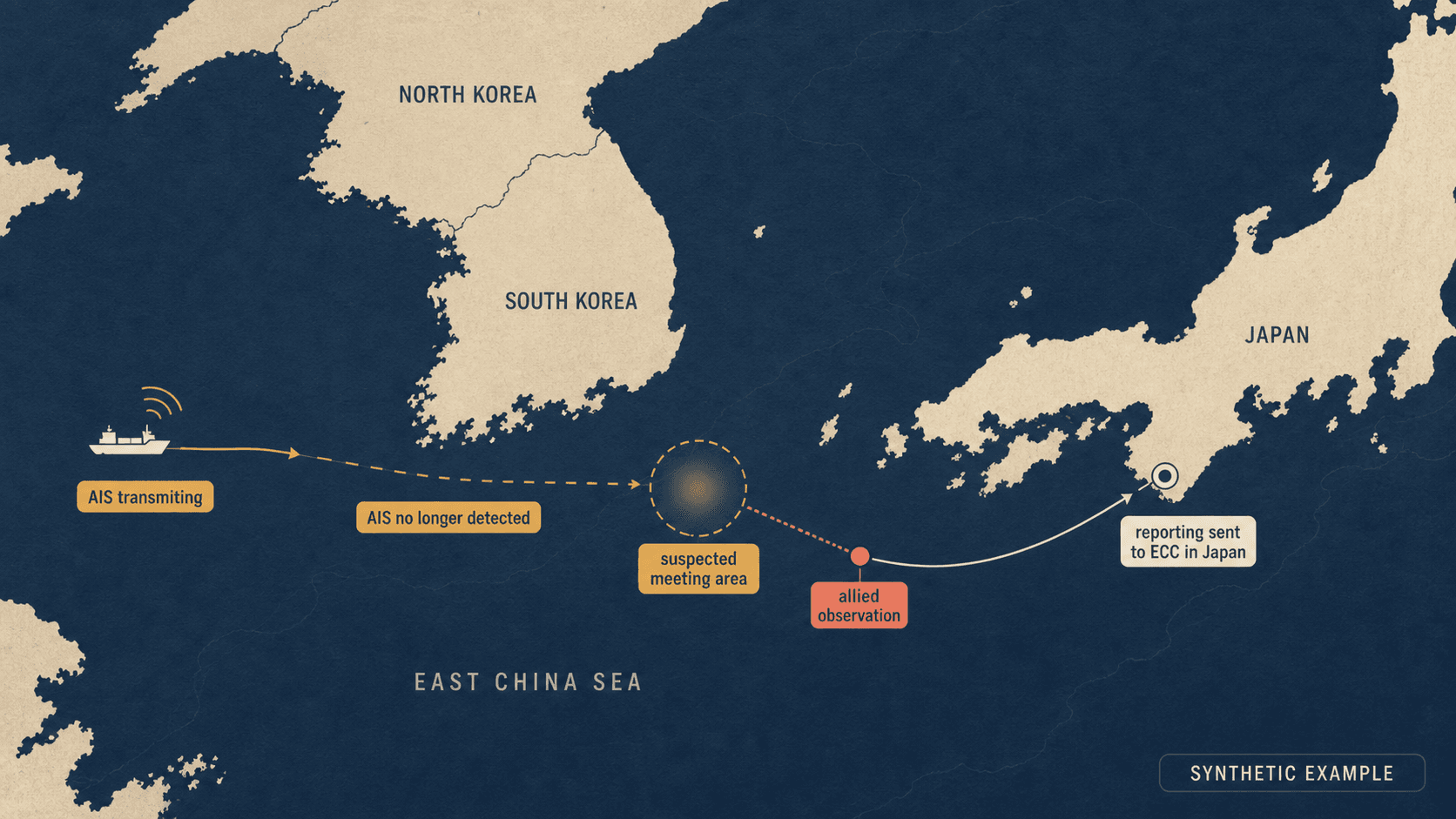
- AIS transmitting
- AIS no longer detected
- Suspected meeting area
- Allied observation
- Reporting sent to the ECC in Japan
The ECC connected what different nations could see
The Enforcement Coordination Cell brought reporting from twelve partner nations into a shared analytical process. Allied naval ships and maritime patrol aircraft operating around the Korean peninsula contributed observations, imagery, vessel reporting, and other collection. Different countries also brought registry information, prior intelligence, regional knowledge, and legal authorities.
The ECC did not command another country's ships, aircraft, or enforcement agencies. Its role was to help coordinate collection, compare what different partners had observed, and create a clearer shared picture of possible sanctions evasion.
When an aircraft or ship observed suspicious behavior, the report still had to be connected to everything already known about the vessel. Analysts needed to determine whether it matched prior activity, whether the vessel had changed identities or ownership, whether another partner had observed related behavior, and what information could legally be shared.
If the evidence supported further action, the team prepared a releasable intelligence product for the government with the authority or opportunity to respond. That government—not the ECC—decided whether to continue monitoring, inspect cargo, restrict port access, interdict a vessel, or take another enforcement action.
Partner collection→ECC assessment→Releasable product→National decision
The watch floor had information, but not a connected history
The initial problem was not a lack of reporting. Useful information lived across separate trackers, historical reports, imagery systems, messages, and partner channels.
When a new observation arrived, analysts often had to rebuild the vessel's history manually. They searched for earlier reporting, compared identifiers, reviewed previous activity, checked whether other partners had reported the same vessel, and reconstructed what had happened during earlier shifts.
- 01
Analysts spent too much time gathering background before they could assess what had changed.
- 02
The quality of review depended heavily on whether the analyst knew where earlier information was stored.
- 03
Context could disappear between systems, shifts, or partner handoffs even when the underlying reports remained available.
The goal was not to collect more data. It was to connect what was already available so a new report arrived with its relevant history.
My role was to redesign the path from reporting to review
As an Operations Manager, I coordinated multinational intelligence collection operations across twelve partner nations within the Pacific Security Maritime Exchange.
I helped map the existing watch-floor process: what information arrived, where it was stored, which steps required repeated manual entry, where duplicate records were being created, and where context was lost between collection, analysis, and dissemination.
I then helped implement Palantir Maven AIP workflows that integrated vessel behavior, intelligence reporting, collection activity, and partner context into a shared operating picture for analysts and senior decision-makers.
The technology was only one part of the work. The larger task was defining how the watch floor should use it:
- what information belonged to the same vessel or network
- which indicators should prompt additional review
- what evidence an analyst needed to see
- how uncertainty and source provenance should be displayed
- what information could be released to each partner
- where an automated step had to stop and a human decision had to begin
Object-based intelligence connected the reports
Previously, each report could become another separate starting point. The revised workflow organized the reporting around the vessel being assessed, keeping its names, companies, locations, encounters, and earlier reports connected to the same history.
When a new observation arrived, it could be associated with the existing vessel record rather than treated as an isolated document. Analysts could review it beside the vessel's previous behavior, known relationships, and earlier assessments.
This did not turn an observation into proof. It created a more complete and traceable picture of what was known, where it came from, what remained uncertain, and why the activity deserved—or did not deserve—further attention.
Before / manual reconstruction
Every report was another starting point.
- Patrol observation
- AIS history
- Imagery
- Partner report
- Ownership record
- Prior assessment
After / connected history
Vessel and network history
- Connected identities
- Movement history
- Encounters
- Reports
- Related companies
- Analyst decisions and review history
AI helped surface patterns and organize the queue
I also helped develop AI-assisted workflows for detection and recognition.
Detection focused on combinations of activity that might warrant review: a tracking gap aligned with unusual movement, an encounter with another vessel, a route deviation, a change in identity, related partner reporting, or activity near a relevant location.
Recognition helped connect new observations to existing vessels, aliases, companies, locations, and relationships. Language-model-supported workflows could extract key details from incoming reporting, summarize relevant history, and present the analyst with the evidence behind an alert.
The system's role was to prioritize information and reduce repetitive work. It did not determine that a violation had occurred.
AI assisted withconnect, compare, summarize, prioritize
Analysts remained responsible forassess, validate, approve, recommend
Analysts still had to ask:
- Do these observations belong to the same vessel?
- Is the activity unusual in context?
- Is there enough evidence to request more collection?
- Can the information be released to the relevant partner?
- What, if any, action should be recommended?
The final product had to be usable by another government
In a multinational environment, an assessment is only useful if it can be shared with the partner able to act.
Every source carried different restrictions. Analysts needed to preserve where the information came from, how confident the assessment was, what remained uncertain, and which details could be released to a particular country.
I helped declassify and disseminate maritime intelligence as releasable products for partner nations. Those products supported governments including Korea, Japan, and Taiwan as they identified, interdicted, and seized vessels violating UN sanctions under their own authorities.
The ECC's role remained coordination and intelligence support. The legal and operational decision belonged to the receiving government.
What changed
75%less manual data entry in the consolidated alert workflow
The workflow also improved continuity between shifts because analysts no longer had to reconstruct the same vessel history from the beginning. Supporting evidence, earlier observations, relationships, uncertainty, and previous decisions remained connected to the object under review.
The result was not an autonomous prediction system or an automated enforcement tool. It was a more disciplined operational workflow:
- less time rebuilding background
- clearer links between observations
- more consistent analyst review
- better evidence provenance
- a more reliable handoff to partner nations
The most important change was that a new report no longer arrived alone. It arrived in context—with its history, relationships, supporting evidence, uncertainty, and available next actions visible to the analyst.